---
title: "Building a Tool-Calling Agent with Vercel's Eve and Running It from the TUI"
description: "A follow-up to my first look: adding tools and evals to Eve, configuring models via the Vercel AI Gateway, invoking tools from the TUI, and exploring the info and eval commands."
lang: "en"
canonical: "https://llm-lab.dev/en/posts/vercel-eve-deep-dive/"
source: "https://llm-lab.dev/en/posts/vercel-eve-deep-dive.md"
publishedAt: "2026-06-20"
updatedAt: "2026-06-20"
category: "eve"
tags:
- "eve"
- "vercel"
- "agent"
- "typescript"
- "ai-gateway"
---
# Building a Tool-Calling Agent with Vercel's Eve and Running It from the TUI
import LinkCard from "../../components/LinkCard.astro";
I outlined the overall picture of Eve in the article below.
I wrote the following article previously.
I had already verified that the local dev server starts up, so this time as a follow-up I wrote and ran actual tools, and confirmed model configuration and tool invocation from the TUI.
At first I tried to verify through the HTTP API and background startup, but in practice the simplest approach was to select a model on the Vercel AI Gateway side with `/model` in Eve's TUI and converse directly. This time I switched to `anthropic/claude-haiku-4.5` and verified that a dummy weather tool gets called.
## What I Built
I added a single dummy weather tool to the minimal project I created last time.
```ts
// agent/tools/get_weather.ts
import { defineTool } from "eve/tools";
import { z } from "zod";
export default defineTool({
description: "Get the current weather for a city. Returns dummy data for local testing.",
inputSchema: z.object({
city: z.string().describe("City name, e.g. Tokyo"),
}),
async execute({ city }) {
return {
city,
temperatureC: 26,
condition: "partly cloudy",
note: "this is dummy data from a local check, not a real weather API",
};
},
});
```
The file name becomes the tool name as-is, and all I had to do was add one line to `instructions.md` saying "when asked about weather, use this tool." No wiring or registration arrays were required. I saw a similar convention in [Flue](https://llm-lab.dev/posts/flue-framework-overview/), but Eve takes it even further with a flat `agent/tools/` convention that doesn't even require nested directories.
```markdown
# Identity
You are a helpful assistant for local framework testing.
- When asked about weather, use the get_weather tool rather than guessing.
- Answer concisely.
```
I also added one eval.
```ts
// evals/weather.eval.ts
import { defineEval } from "eve/evals";
import { includes } from "eve/evals/expect";
export default defineEval({
description: "The assistant uses get_weather and reports the dummy Tokyo weather result.",
async test(t) {
await t.send("東京の天気を教えてください");
t.completed();
t.calledTool("get_weather", { output: { city: "Tokyo", condition: "partly cloudy" } });
t.check(t.reply, includes("26°C"));
t.check(t.reply, includes("ダミー"));
},
});
```
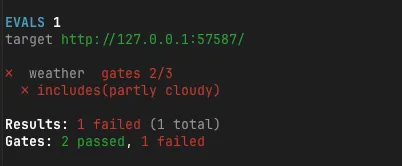
At first I used `t.check(t.reply, includes("partly cloudy"))`, but when I ran it the `condition` in the tool output was `partly cloudy` while the final response rephrased it into Japanese as something like "曇りのち晴れ" (partly cloudy). So I changed my approach: I verify `condition` through `t.calledTool(...)` output assertions, and check the user-facing response for text that actually appears, such as `26°C` or "ダミー" (dummy).
Being able to assert tool invocations themselves with `t.calledTool(...)` feels like a writing style that bridges unit tests and E2E tests, and it struck me as subtly useful. On the other hand, since English tool values don't necessarily appear verbatim in the final natural-language response, it's more stable to separate what you verify through tool output from what you verify through response text.
## Changing the Model from the TUI
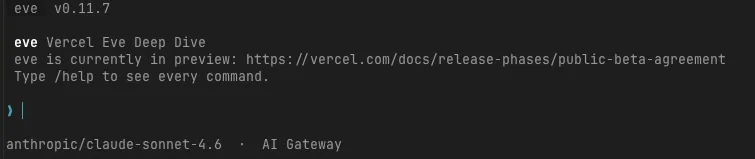
I started the TUI with `npm exec -- eve dev` and ran `/model` first. Changing the model to `anthropic/claude-haiku-4.5` here makes it active from the next prompt.
```text
▌ /model
⎿ Model changed to anthropic/claude-haiku-4.5. Live on your next prompt.
```
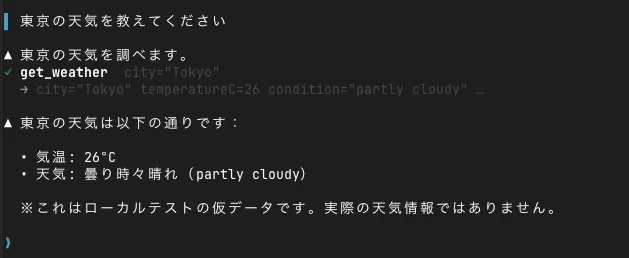
When I asked about the weather, Eve invoked the `get_weather` tool, read the result, and replied in Japanese.
```text
▌ 東京の天気を教えてください
▲ 東京の天気を調べます。
✓ get_weather city="Tokyo"
→ city="Tokyo" temperatureC=26 condition="partly cloudy" …
▲ 東京の天気は以下の通りです:
• 気温: 26°C
• 天気: 曇り時々晴れ(partly cloudy)
※ これはローカルテストの仮データです。実際の天気情報ではありません。
```
What I confirmed here is that simply placing a file at `agent/tools/get_weather.ts` is enough for the tool to be discovered and naturally invoked by the model. I didn't write any explicit arrays or routing code for tool registration.
## The Build Passed Without Issues
```
eve build
```
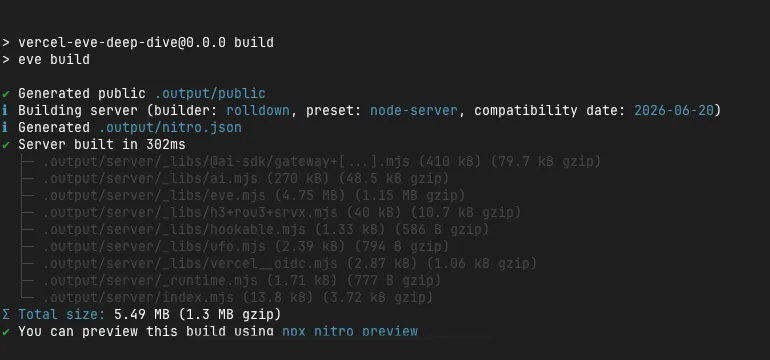
Running this produced a Nitro-based server.
```
[nitro] √ Building server (builder: rolldown, preset: node-server, ...)
├─ .output/server/_libs/@ai-sdk/gateway+[...].mjs (409 kB)
├─ .output/server/_libs/ai.mjs (270 kB)
├─ .output/server/_libs/eve.mjs (4.67 MB)
...
[BUILD] built output at /path/to/my-agent/.output
```
As you can see from the fact that `@ai-sdk/gateway` is bundled from the start, Eve is built on the assumption that model provider access is unified through the Vercel AI Gateway. While you can specify something like `anthropic/claude-sonnet-4-6` as if hitting Anthropic directly, the actual architecture routes through the AI Gateway. This is worth keeping in mind, as it also relates to a stumbling block I'll mention later.
## A Small Pitfall with Background Process Management
This is a bit off-topic from the main subject, but I'm writing it down as an implementation note. While restarting `eve dev` several times, I repeatedly encountered a situation where a naive `nohup ... &` approach caused the process to die after a few seconds, making `curl` return `Connection refused`. Switching to `setsid` to detach from the session stabilized things. I was reminded that when running CLI tools in the background for verification, you need to pay attention to how shell job management behaves.
## Setting the AI_GATEWAY_API_KEY and Proceeding in the TUI
Eve's string model IDs, such as `anthropic/claude-haiku-4.5`, are resolved through the Vercel AI Gateway. So to run locally, you place your Vercel AI Gateway API key in `.env.local`.
```text
AI_GATEWAY_API_KEY="..."
```
With this in place, starting `npm exec -- eve dev` and using `/model` in the TUI lets you change models and try conversations on the spot. In this verification, after switching to `anthropic/claude-haiku-4.5`, I got through the weather question to the `get_weather` invocation.
There is also a way to hit the HTTP API directly, but for first-time verification the TUI is easier to work with because you can see model changes, tool invocations, and responses in one place. If you want screenshots, it's worth capturing the model change display after `/model` and the conversation where `get_weather` was called.
## The Full Picture of Built-in Tools, Revealed by an Error Payload
Now that I could see `get_weather` being called in the TUI, I became curious about what built-in tools Eve's agent has beyond custom ones. Comparing the documentation with the compilation results, I found the following standard tools available in addition to the ones I defined myself.
In addition to my custom `get_weather`, these tools were built in from the start:
| Tool Name | Role |
|---|---|
| `ask_question` | Ask the user a multiple-choice question and wait for a response |
| `bash` | Execute shell commands inside a sandbox |
| `glob` | Search files by pattern |
| `grep` | Search file contents with a regular expression |
| `read_file` | Read a file |
| `write_file` | Write a file ( constrained to fail unless the existing file was read first ) |
| `todo` | Manage a task list within the session |
| `web_fetch` | Fetch a URL and convert it to markdown/text/html |
| `web_search` | Web search provided by Anthropic (implemented as `type: provider`) |
| `load_skill` | Load the full instructions of available skills |
The fact that `bash`, `read_file`, `write_file`, `glob`, and `grep` are available by default is especially notable. It means the feature introduced in the blog post of "having the agent write and execute its own code" (the example of `write_file analysis/by_region.py` followed by `bash python analysis/by_region.py`) is enabled from the start without any special configuration. In Flue you had to explicitly select a sandbox like `sandbox: local()`, but Eve seems to default to a "general-purpose agent with a sandbox."
Looked at from the other side, this also means the security assumptions differ from Flue's. According to the blog post, Eve's sandbox is "a segregated environment running in a separate security context from the harness," with Vercel Sandbox at deploy time and Docker, microsandbox, or just-bash as adapters for local use. So even though `bash` is available from the start, the premise is that its execution target is not the application runtime itself but an isolated separate environment. Where Flue's `local()` was "a trusted-environment-only choice that accesses the host directly," Eve thickens its built-in tools from a "sandboxed from the start" stance. Seeing this difference in design philosophy was one of the takeaways from this session.
That said, the only tool I actually invoked in this verification was my custom `get_weather`. How built-in tools like `bash` and `write_file` map to specific sandbox backends in a local environment still needs to be verified separately.
## The Eval Command Also Needs a Config File
When I tried `eve eval`, I hit another stumbling block.
```
Missing required eval config at evals/evals.config.ts.
Create it with defineEvalConfig({}) (optionally `{ judge: { model } }` to set
the default judge model for `t.judge.*` assertions).
```
It seems there are not only deterministic assertions like `t.check(t.reply, includes(...))` but also LLM-as-judge-style `t.judge.*` assertions, and this config is where you specify the default judge model. For now, placing just `defineEvalConfig({})` is enough to start writing deterministic evals like the ones I used here.
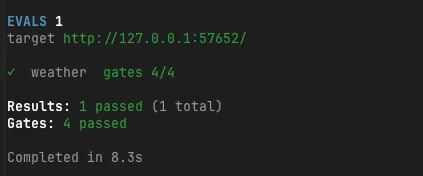
When I ran it once, `completed` and `calledTool(get_weather)` passed, but `includes(partly cloudy)` failed. This is because while `partly cloudy` was in the tool output, the model rephrased it into Japanese in the final response. When writing evals, you need to think separately about whether you're verifying internal structured output or the natural language returned to the user.
After splitting the expected values and rerunning, all four gates passed.
```text
✓ weather gates 4/4
Results: 1 passed (1 total)
Gates: 4 passed
```
## Internal Structure Revealed by the info Command
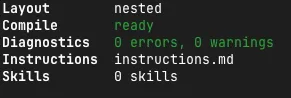
Finally, I checked the compiled internal state with `eve info`.
```
Application
App Root /path/to/my-agent
Agent Root /path/to/my-agent/agent
Layout nested
Compile ready
Diagnostics 0 errors, 0 warnings
Instructions instructions.md
Skills 0 skills
Artifacts
Compiled Manifest .eve/compile/compiled-agent-manifest.json
Discovery Manifest .eve/discovery/agent-discovery-manifest.json
...
Messaging
Create POST /eve/v1/session
Continue POST /eve/v1/session/:sessionId
Stream GET /eve/v1/session/:sessionId/stream
```
The `Skills 0 skills` display tells us that tools (`tools/`) and skills (`skills/`) are counted under separate jurisdictions inside Eve. Since I didn't create any skills this time, this is a consistent result. The build output being persisted as a JSON manifest under `.eve/` is also conceptually similar to Flue's build-time manifest. The pattern of generating structured execution data from declarative file layout feels quite common across this generation of agent frameworks.
## Summary
What I learned from this verification comes down to three points:
1. **The TUI is the simplest way to verify**: From `npm exec -- eve dev`, change the model via `/model` and converse directly to see the flow of model switching and tool invocation clearly.
2. **Tools appear from file placement alone**: Placing `agent/tools/get_weather.ts` and writing the policy in instructions was enough for `get_weather` to be called by the model.
3. **Evals need a config file**: Without `evals.config.ts` containing `defineEvalConfig({})`, `eve eval` won't run. Even the first eval requires the overhead of writing this config file.
The design that thickly embeds execution capabilities including `bash`, `read_file`, and `write_file` from the start contrasts sharply with Flue's "sandbox is something you explicitly choose" design. It's not a matter of which is better; my main impression this time is that the default safety posture differs.
If I were to try more next, I'd like to demo actual code generation and execution with the `bash` tool, evals using `t.judge.*`, and progressing to actual Slack channel integration. Since Slack integration wasn't verified this time, I'll probably split that into a separate article.